
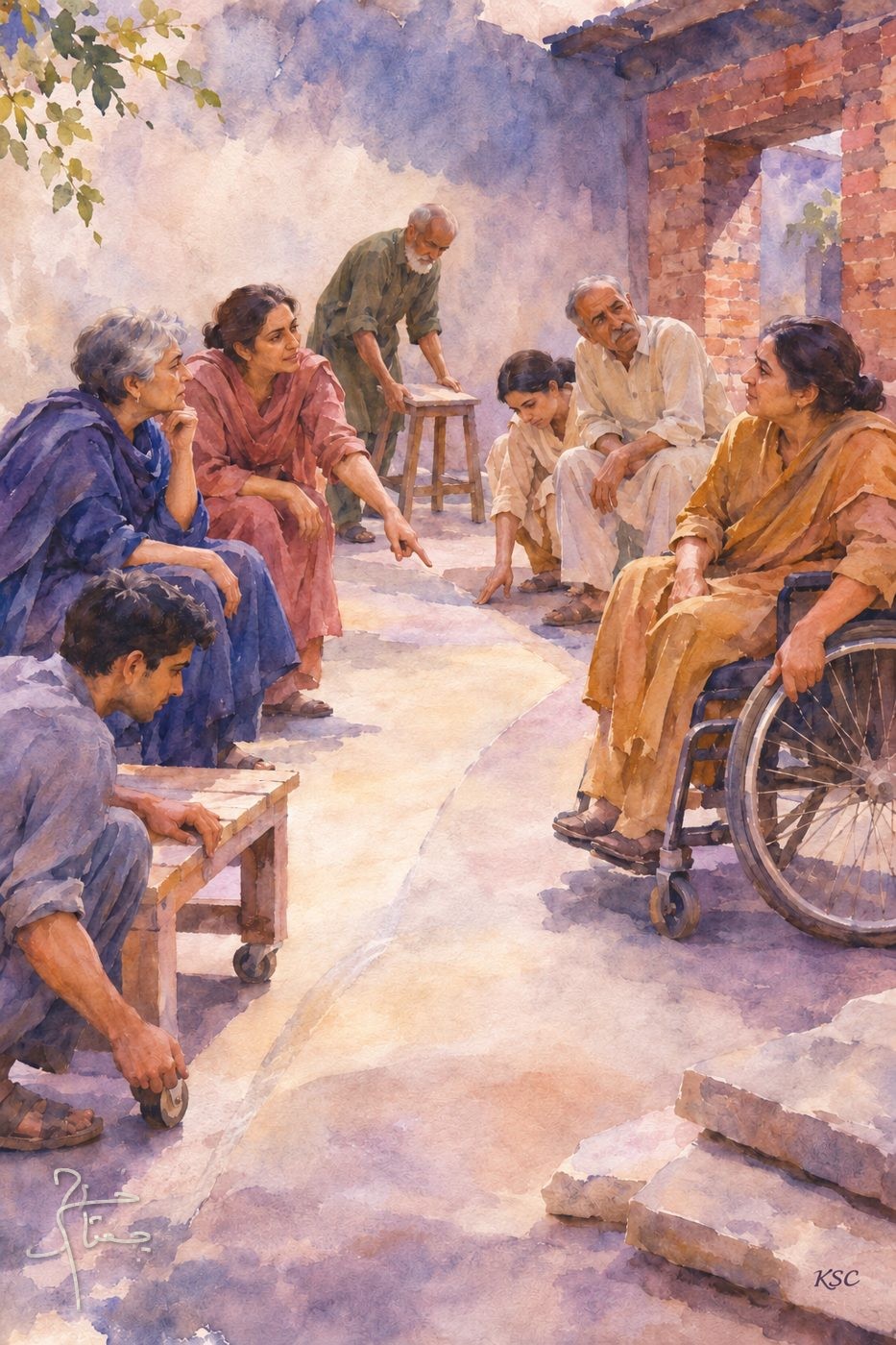
The State shall discourage parochial, racial, tribal, sectarian and provincial prejudices among the citizens.
Text in force · official consolidation, as amended to 21 November 2025
JUS.smart answers from the text of this Article and the records on this site, and names the Articles it read.
History of this article
No amendment is recorded.
The official consolidation records no insertion, substitution or omission in Article 33 since the Constitution was made in 1973.
In Reconstituting Public Power
Article 33 in the five Books.
Khurram Chughtai's discussion of this article: the Topics that address it, with the sentence that names it, the author's doctrines they apply and the judgments their notes rely on. Drawn from the text by machine; each Topic opens in the reader.
- Topic 105The President: election, term and the immunity of the election (Constitution of 1956, arts 32, 33 and 35)Chapter 5, The 1956 Constitution and the Crisis of Federal SettlementAn electoral college of the three Assemblies. Article 33(1) gave a term of five years from the date of entry upon office, with a proviso that the President continued in office notwithstanding the expiry of his term until his successor entered upon office.
- Topic 130A constitution written around the administrationChapter 6, The 1962 Constitution and the Presidential Administrative StateWhat the instrument was, and who made it. The Ministers were a President’s Council of Ministers appointed to assist him (Article 33); they were not collectively responsible to any House.
- Topic 142Executive authority, and officers subordinate to him (Constitution of 1962, art 31)Chapter 6, The 1962 Constitution and the Presidential Administrative StateThe administrative sentence of the Republic.
- Topic 144The Council of Ministers and the Parliamentary Secretaries (Constitution of 1962, arts 33 to 35)Chapter 6, The 1962 Constitution and the Presidential Administrative StateMinisters to assist, not a Cabinet to advise. Article 33: “To assist him in the performance of his functions, the President may, from amongst persons qualified to be elected as members of the National Assembly, appoint persons to be members of a Council of Ministers, to be known as the President’s Council of Ministers.” Article 34 required a…
- Topic 152Provincial government without a Chief Minister (Constitution of 1962, arts 71 to 73)Chapter 6, The 1962 Constitution and the Presidential Administrative StateThe Assembly. With the President’s concurrence under Article 82, the Governor might appoint a Council of Ministers to assist him, and Parliamentary Secretaries from among the members of the Assembly, upon the same model as Articles 33 and 35 at the Centre.
- Topic 196Parliamentary government restoredChapter 8, The 1973 Constitutional SettlementThe hinge put back. That is the reverse of Articles 31 and 33 of the Constitution of 1962, in which executive authority vested in the President and the Ministers were his council appointed to assist him, and the reverse also of Articles 62 and 63 of the Interim Constitution of 1972, under which the Ministers held at his pleasure.
- Topic 231The four dissolutionsChapter 9, Constitutional Interruptions, Validation and Institutional ReconfigurationThe uses, and their outcomes. Article 33 of the Constitution of 1962 made Ministers a council to assist the President.
- Topic 246The paradox of local devolutionChapter 10, Devolution, Recentralisation and the Post-2000 OrderThe two local-government systems, and which proved the weaker.
- Topic 252Police reform: the Order of 2002Chapter 10, Devolution, Recentralisation and the Post-2000 OrderA separate instrument, a year later. Article 9 vested superintendence in the appropriate Government, while Article 33 made the head of district police responsible to the Zila Nazim for police functions but excluded administration, criminal investigation and prosecution from that responsibility.
- Topic 866Recognition must protect those within the new minorityChapter 49, Territorial JusticeIdentity can ground a claim to public voice. The Principles of Policy add the duties to discourage parochial and other specified prejudices under Article 33 and to safeguard minority interests, including due service representation, under Article 36.
- Topic 870Distinct constitutional positions require distinct remediesChapter 49, Territorial JusticeGilgit-Baltistan and Azad Jammu and Kashmir are not Provinces. Article 33 also requires prior approval of the Government of Pakistan for amendment of Articles 31, 33 and 56.
- Topic 881A commission capable of independent public inquiryChapter 51, Constitutional Procedure for Territorial ReorganisationExpertise should make the legislative choice better informed. The draft permits threshold dismissal for non-contiguous enclaves, claims resting exclusively on grounds described as forbidden by Article 33, or repetition within three years of a proposal rejected on its merits.
The twelve Topics that discuss Article 33 most closely are shown, of 13 in 8 chapters.
Doctrines of the author applied
- Territorial justice1 Topic discussing Article 33 · first stated in Topic 2
Judgments relied on
- Civil Aviation Authority v Supreme Appellate Court Gilgit-Baltistan PLD 2019 SC 357cited in 2 notes
- Al-Jehad Trust v Federation of Pakistan PLD 1997 SC 84cited in 1 note
- Al-Jehad Trust v Federation of Pakistan PLD 1996 SC 324cited in 1 note
- Federation of Pakistan v Haji Muhammad Saifullah Khan PLD 1989 SC 166cited in 1 note
- Khawaja Ahmad Tariq Rahim v Federation of Pakistan PLD 1992 SC 646cited in 1 note
- Muhammad Nawaz Sharif v President of Pakistan PLD 1993 SC 473cited in 1 note
- Mohtarma Benazir Bhutto v President of Pakistan PLD 1998 SC 388cited in 1 note
- Khawaja Muhammad Sharif v Federation of Pakistan PLD 1988 Lah 725cited in 1 note
- Qazi Hussain Ahmad v General Pervez Musharraf PLD 2002 SC 853cited in 1 note
- M Q M (Pakistan) v Pakistan PLD 2022 SC 439cited in 1 note